Opinions of experts and specialists
EXCERPTS FROM A CONVERSATION WITH PAWEŁ ZAWITKOWSKI
Physiotherapist at the Mother and Child Institute in Warsaw

So what shoes are best for children?
Those that do not interfere with the feet's movement and contact with the ground. Not too tight and no longer than half a centimeter from the foot, made of “breathable” material (e.g., leather, Gore-Tex). They should bend and be stiff where the feet bend and stiffen. This means that they should bend at the ankle (forward and backward) and under the toes. The shoe should be soft, with a thin, flexible and slightly rounded sole at the front and back. They should also be as narrow as possible, so that the child's foot does not slide to the middle and become crooked. Sports shoes are best, preferably lace-up ones - they adapt to the movement and shape of the foot when walking. The heel counter should move with the heel – you can tell if it is too hard by the fact that it wears out, because the child's heel does not move with it, but slides over it. This means that the shoe does not “hold” the foot, so it should be thrown away. Children should walk in their shoes, not carry them!
What mistakes do parents make when buying shoes?
They follow old myths that a good shoe should be high-top, have a hard sole, and a rigid heel counter. For a child, walking in something like that is like marching in ski boots! Parents do this because they want to protect their child. However, it’s better to give the toddler and their feet maximum freedom – let them run wild. When a child starts walking, they often have valgus feet. Do they need corrective footwear?
Absolutely not!
To reduce the natural bow-leggedness of feet at this age, you need to let your child run, jump, and climb. When they are learning to walk, they “catch” their balance with their feet. It is much easier for them to do this... barefoot than in stiff or loose shoes. In such footwear, they will often fall over and their feet will develop less well. Over time, this can even lead to poor posture and poor grades in physical education. Shoes really do make a big difference.
Source: Rodzice 10/2006
Author: Lidia Butowska
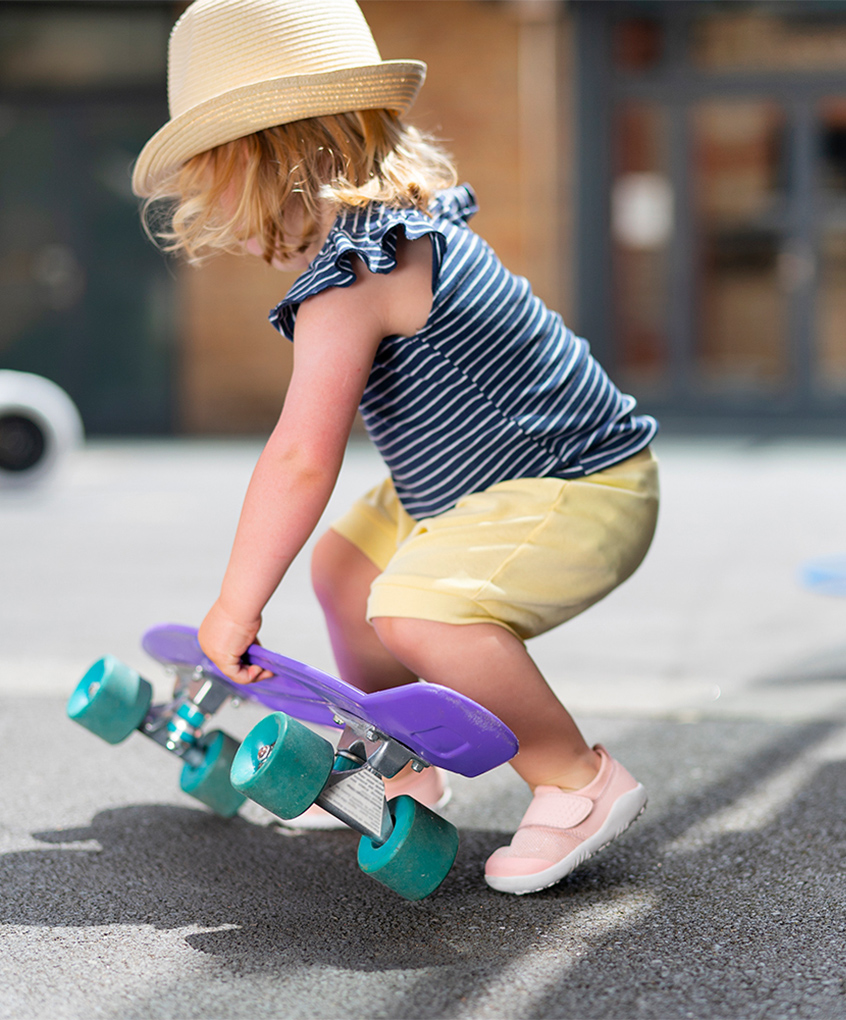

Iwona Jańczewska, MD, pediatric specialist

"It is not advisable to put stiff shoes on your child at home, just as we do not put stiff gloves on our hands. The foot does not need support, but mobility and freedom. Children love to run barefoot and probably know what they are doing. Walking without shoes is excellent exercise for little feet, as the toes bend freely, which helps to develop the muscles and arch of the foot.... „
TRACY BYRNE
Leading pediatrician in the UK, Bobux consultant

- It has been observed that young children develop better posture when walking without shoes. When walking barefoot, more information from the ground reaches their brain, so they don't need to look down as often - this helps them maintain balance and learn to walk. Walking barefoot develops the muscles and ligaments of the foot, increases the strength of the arch of the foot, improves proprioception (our awareness of where we are in relation to the space around us), and contributes to good posture.


Translation of an article by Doctor of Chiropractic
Lisy C. Moore

As a small foot grows, it is important for the bones, muscles, blood vessels, and nerves to have space for unrestricted development. When a child begins to take their first steps, the muscles of the feet work and the toes naturally spread apart for better control and balance. When we enclose the foot in a stiff shoe, the toes cannot move naturally, and the muscles and bones of the foot cannot develop freely. Foot health depends on the flexibility of the structures involved in walking. Stiff shoes prevent these structures from developing, which can ultimately lead to conditions such as arthritis. From a chiropractic point of view, the health of the spine depends on the health of the feet.
Stiff feet have a negative impact on all joints above, including the spine. The same applies to the pelvis, where an incorrectly shaped foot often causes problems. Children's shoes with soft soles allow the foot to develop properly, forming strong ankles and flexible foot bones. A healthy foot is a solid foundation for the bones and muscles of the rest of the body.
Translation of an article by Lisa C. Moore, Doctor of Chiropractic (Auburn, California).
Translation of an article from the Hartford Courant

Translation of an article from the Hartford Courant Old parental wisdom says that children should wear stiff leather shoes–but that's not true, according to researchers at the Connecticut Children's Medical Center, who spent two months studying how children learn to walk.
Using pressure sensors connected to a computer and slow-motion video recordings, the researchers discovered that from the very first steps, a child's foot moves from heel to toe, just like an adult's. This disproved the belief that the first steps were taken with flat feet, which in turn was the basis for the creation of stiff shoes with high heels and ankle supports.
However, it turned out that children's ankles work while walking and are stable from the beginning, so traditional high shoes are inappropriate.
The conclusion, according to Sylvia Ounpuu, a movement specialist at the Center for Child Health who led the research, is that bare feet are best for children's feet.


PHYSIOTHERAPIST EWA KOWALCZYK

A child's foot is not simply a smaller version of an adult's foot. The differences are significant. First of all, a child's foot consists of cartilaginous parts, which makes it more susceptible to deformation than an adult's foot. Therefore, it is important that a child's shoe does not squeeze the foot at any point and is not stiff. Secondly, a child's foot is wider at the toes and narrower at the heel, so shoes should not be narrowed at the front. Children's feet adapt much better to the ground than adult feet, do not need additional insoles or stiffeners, and develop best when moving freely.
Bobux shoes do not restrict foot movement, are flexible and very light. They leave enough room for the child's toes. Many of my patients have told me that these were the first shoes that did not “bother” their child when walking and that their child was happy to wear, which is the best review of children's shoes in my opinion.
- fizjoterapeutka Ewa Kowalczyk
ewakowalczyk@mama.fizjoterapeutka
MAGDALENA ZUJEWICZ

We know very well that a healthy foot is a bare foot. Toddlers who are learning to walk should walk barefoot for as long as possible because a child's foot works best and develops properly when it is not restricted in any way. A child's foot is made up of a layer of fat that disappears around the age of 5, which is why it may seem to us that the toddler has flat feet until then. Don't worry, this is normal at the beginning. It is also normal for a toddler who is learning to walk to walk with a wide stance, but this should change over time. Everything is fine as long as we can let our child walk barefoot, but the problem arises when it gets cold and we need to protect their little feet outside. This is where Bobux shoes come in handy. They meet all the criteria for ideal shoes. What are they?
1. The sole of the shoe is flexible, meaning that the shoe should bend in all directions.
2. 1/3 of the shoe bends freely and ensures freedom of movement.
3. The upper ends before the ankle–it does not restrict movement. In the case of winter shoes, it can be above the ankle, but it still cannot restrict the movement of the foot.
4. The heel counter is moderately stiff to allow the ankle joint to function properly.
5. No preventive insoles. Insoles are not necessary for healthy feet.